Saturday, December 23, 2017

Gaynor Paynter - a short bio

Who is the person behind Typewrite Transcription and Editing Services CC?
Gran and I (1975)

Gaynor Paynter – a short bio

I was born on the 21st of March 1975 in Kensington, South Africa, and, with the exception of a few years after I was married in 1996, I’ve lived here my whole life.

I went to school at Leicester Road Primary School and Jeppe Girls High where I matriculated in 1992 with a university exemption and half colours for chess (I was the captain of the chess team and was on the tennis team too).

After studying graphic design for a year, I decided it wasn’t for me and did a secretarial diploma at the then Germiston Technical College (in which I obtained a distinction in Information Processing, a fancy name for typing).

I always had an entrepreneurial flair. During school I sold artwork through advertising in the Top 40 Music Magazine, for R5 a piece! (Lots of drawings of Michael Jackson were done at the time!) I also worked part time in the local Checkers.

At Rhodes Park in Kensington about 1988A lot of firsts

My first full time job was at a company called KMI in Heriotdale in 1995 where I did reception and admin – and where I was exposed to transcribing for the very first time, transcribing notes made by one of my bosses on a small microcassette recorder!

Damian and I 2012

In 1996 I married my first, only, and still current husband, Damian, and my first son, Andrew, came along in 1998. During this time the development of technology was moving fast. Our first cellphone was the Nokia 2110 and it was an amazing phone which we shared. The very first time I went on the internet was in KMI’s showroom, during a lunch break (I surreptitiously snuck in to go on to say I’d been on!)

Getting older and getting experience

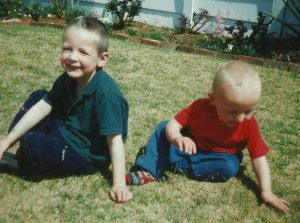
My babies Andrew and  Brandon about 2002The company ran into some difficulty and I was retrenched in the year 2000. I advertised to do typing work and did some temp jobs. I then fell pregnant with my second son, Brandon – but one employer took me on ‘semi permanently which became permanent’ – at a recruitment company, where I prepared CVs and interviewed candidates.

 The birth of Typewrite

By 2005, the internet had progressed enough for me to ‘birth’ Typewrite Transcription and Typing Services CC. (Now Typewrite Transcription and Editing Services). For three months, I worked at the recruitment company during the day, and on Typewrite by night, all the while with a husband and two little boys.

The 1st of April 2005 was the first ‘official’ day of Typewrite, although it didn’t come to be registered at CIPRO (now CIPC) until 2009.

Milestones

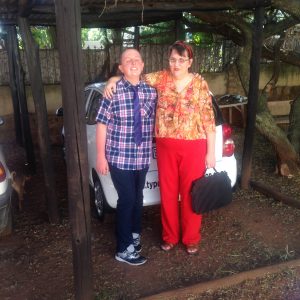
Brandon and I 2016Various milestones flag this journey. When I started I still had dial up internet. I had to soldier on with this for about a month until our ADSL was installed. You also have to have a back up internet and I’ve been through various of those, until my current ‘back up’ – my MTN cellphone. (I’ve had the same number since 1995, by the way!) Services provided have also grown and diversified – starting out with typing, adding transcribing, adding proofreading – and just recently, adding sub-titling.

Becoming an author
In 2009 I wrote my e -book  “Working From Home as a Transcriptionist in South Africa” which is a great resource for those starting out today – as I found when I started out, there wasn’t much if anything in the way of support!


TAVASA
The same year my friend and colleague Alison Fourie and I founded TAVASA – the Transcriptionists and Virtual Assistants of South Africa.

The future

Today, going into 2018, the company is still in existence – we’ve been married 21 years, and those little boys are now 17 and 19.  I’ve had the support of my husband, parents, children – and my two dogs, Scooter and Shadow.  I’m looking forward to seeing what the future holds.

Monday, November 13, 2017

Who needs a professional editor?


The question of who needs a professional editor is one I've come across a number of times. I decided it would be beneficial to post the answer here.

It's important to note that in this instance I'm referring to a WRITING editor. Not a music or video editor.

Firstly, a preamble: What is an editor?  An editor is more than someone who simply checks your grammar. An editor will make suggestions regarding content (when applicable) and style. He or she will check your formatting and lay the document out for publishing whether it be online, as a thesis or scholarly paper, a magazine article, journal, etc 

Who needs an editor?

Anyone writing a document for publication - students, authors, business people.

The reason for this is simple. Even though English may be your first language, it's very hard to spot your own mistakes. And a published document is a representation of you and / or your employer. A published mistake is a slur on your or your employer's reputation. It's no discredit to you to admit you've used an editor - in fact, anyone who knows this will appreciate your professionalism.

Someone who is writing in a language that is not their first language.

It's important to ask a first-language speaker to assist you to check that you've got all the nuances and idiosyncrasies correct. 

Someone who doesn't consider language or writing to be their strength.

We all have different strengths - I have to hire a plumber or a mechanic,  I just can't do those things. Therefore, if you are not confident in your language skills, using them to market your business might not be the best idea.  A recent example I've seen is someone advertising Christmas signs. The signs say (for example) "Christmas at the Smith's". It makes me want to ask "what smith? The blacksmith?

Have a look at my new website, Check My Writing.  Should you still have questions, or feel that YOU need an editor, contact me.

Thursday, April 20, 2017

Online marketing and other bits


So, it's been a while since I posted here .... but I met with a friend of mine today who has recently begun working in a start up (they do furniture and woodwork), and being a 'veteran' of being self-employed, I (annoyingly, probably) dished out advice.... but it was a great conversation and got me thinking. There are a number of things I did when I started out, marketing wise and also discipline wise. These things tend to fall by the way side as we go along and sometimes it does us good to remember them and do them again. Also there are things we learn along the way that are good to keep in mind.

1). Take it one day at a time. Sometimes things can get very overwhelming when you've just started out, you're used to having a salary, and suddenly month end is coming and there's no salary. Try to make plans before you start out and cover a few months' rent, medical aid etc. But spending all your time worrying about tomorrow impacts on how productive you can be today.

2). Take marketing breaks not tea breaks. This is something my friend and colleague Alison Fourie of AMF Typing told me. I haven't always followed this, but when I do, my sales esclate.

3). Set up a website. This may not sound like rocket science, but sometimes people are daunted by the whole idea of a website. The advent of things like WordPress, however, make setting up a site much less daunting than it needs to be. You simply register your domain with a service provider, and go from there. If you have funds available you can also employ a web designer. And something I learned after a while is that it's much better to have an email address with your own domain name than with a generic provider.

4). Social media. Social media can be a full time job if you do all the things there are available. There are so many outlets. Facebook, Twitter, Instagram, Pinterest, Linked In, Google Plus. My feel is that it's better to stick to a few of these and do them properly than go all out with too many and get none of them right. My personal favourites are Facebook, Twitter and Linked In. I feel that they all have different benefits. Linked In in particular is a great place to showcase your experience and skills. But make sure that your profile is extensive and detailed otherwise it may work against you. Facebook is simply the most popular platform. And Twitter has a wide open reach which gives you great exposure.

5). Your work is your reputation. Provide a good quality service and your work will sell itself.

6). Print and distribute brochures, brand your car, put up posters and signs on community boards and in local libraries. Do everything you can to get your name out there.


Tuesday, December 29, 2015

Send a file from a cellphone to a computer using Whatsapp


More and more people use their smartphones as a means to record and use Whatsapp as a method of communication. 

It often happens then that once the recording is done, they wonder how to get the recording sent to the transcriptionist. 

In a climate that is relying more and more on cellular technology (and where cellphones are used to access the internet more than computers are), I thought it would be worthwhile to explain that it is possible to send audio via Whatsapp to a computer. 

All the client has to do is send the file to your cell number as they would normally send a Whatsapp message. 

You then do the following:
1. Go to settings in your Whatsapp account on your phone. 
2. Click Whatsapp Web
3. Go to web.whatsapp.com on your computer and scan the QR code
4. You will see your messages on the left hand side. 
5. Click on the relevant message and you will be able to download the file. 

You obviously need a good internet connection to do this - I recommend wifi for cellphone and ADSL or wifi for computer. 

Wednesday, October 21, 2015

Tips on Audio Recording


The way that an audio file is recorded greatly influences the quality of the transcript. There’s no two ways about this and no way around it, no matter how good the transcriptionist. Although there is software that can help clean it up this is both time consuming and not always efficient.I do not offer recording as a service as it is a speciality on its own, but there are a number of options you as a client who needs something recorded have. The first is to outsource the function and this is probably the most secure, with the best guarantee that you will get a good recording. For this purpose I recommend AMD Solutions and if you use their services please let them know that I recommended them.


audio_ds-2500__front_left_xlThe second way is to do it yourself. There are a number of ways to do this, and if you talk to the guys at Maynards  they will be able to recommend a good recording solution.  You can also use your cellphone or laptop using recording software, but you may not be guaranteed a good outcome.
If you are doing your own recording, there are some things to bear in mind to make it as clear as possible.
  1. Try to record in a quiet place. Loud background noise, while it may not be obvious to you sitting in a restaurant or shopping centre, is very obvious to the transcriptionist trying to make out a particular voice from many in the background.
  2. Try to minimise distractions such as ringing phones, dogs barking or children making a noise.
  3. If there are a variety of speakers, you can ask each speaker to clearly identify and introduce him or herself.
  4. Record a few seconds of ambient noise. This is the room sounds without anybody talking. This allows anyone cleaning up the recording to use that section of recording as a noise sample and use software to remove that type of noise from the recording.
  5. Try to make sure that all speakers speak directly and clearly into the microphone. If someone is sitting across the table and not speaking into the microphone, that person’s contribution may be lost.
  6. Try not to record in the vicinity of loud machinery or activities.
  7. Some form of noise is inevitable and expected in transcripts, but much can be avoided.

Tuesday, October 20, 2015

Audacity Noise Removal

I have recently discovered how to clean up audio using the freeware software Audacity and I thought I would share it.

This might not be rocket science to anyone else, but it took me a while to discover.

When I say this I should point out that it is versions of Audacity before version 2.1.0 that I am referring to. You can talk about being on the slow bus, but I haven't figured out the supposedly much improved 'Noise Reduction' function of later versions. Anyway, it's actually fairly simple when you know how.

1) Open Audacity.
2) Load your audio file.
3) Select a small section of the file that contains the noise you want to get rid of.
4) Go to the Noise Removal function in the Effects tab.
5) Click 'Get Noise Profile' and here it will allow you to get a preview of what your new file will sound like.

6) Go back to your file and select the whole thing.
7) Go back to Noise Removal and hit 'remove noise'.


 Bob's your uncle! It takes a while to do fairly big files and then to save them as well - but I have achieved some very good results doing this. It's prudent, if you have any control over how the file is being recorded, to record a few seconds of ambient noise - meaning just room noise without talking. Then, when you get to Audacity, this will be the section you select for your noise profile, and all similar sounding noise will be removed from your file.

Monday, May 04, 2015

Why a Transcriptionist is beneficial in the Insurance Industry

The transcription service is relevant and beneficial in just about any industry.  Small business owners become stressed with the amount of work load they have and being able to outsource functions saves stress and makes life easier and larger companies can outsource this function in order to streamline their operation. Insurance administration can be a nightmare if you try to handle it on your own. So why not get a professional to help?

If you work in the insurance industry, you probably record your phone calls and dictate your reports. If you own your own small business, you probably do the work later on yourself. Both of these can be uploaded and sent to a transcriptionist to type. This is cheaper than having a permanently employed member of staff, and you don't have to worry about overheads like salaries, electricity and equipment. The transcriptionist, as a freelancer or a business owner, takes care of this. 

Because this function may not be your strength, it can also be to your benefit to have someone more proficient at it do it. They will be faster, more efficient, and it will leave you  more time to tackle your strength - which is running your business. 

This means that by the time you get back to your office, your calls and reports can be ready and waiting for you at your desk.  It can be helpful to you if you work at your desk or if you are on site doing assessments.  The time you save doing this helps you achieve a faster turn around time and makes you look more efficient in the eyes of your client. 

Larger insurance companies, which make use of call centres and other larger groups of staff, can also benefit by using a transcriptionist.  All call centre, telephone and admin staff can send out their calls to be transcribed, leaving them free to process calls and handle the administration functions. This leads to a much more stress free environment. 

All forms of insurance companies and insurance consultants can benefit from this - life insurance, pension, liability insurance, auto insurance, medical insurance or medical aid, property insurance, funeral cover, etc - even pet insurance! - giving you peace of mind to keep customers happy. 

To summarise, the benefits include:
- Saving stress
- Making life easier
- Streamlining the operation 
- Cost reduction
- Increased efficiency

Contact me for a quote on typing and transcription services today. 

Monday, May 19, 2014

S is for Story Pot

Interview with Damaria Senne - author of amongst many things the Story Pot Blog. 

Essentially Damaria, who is a long term friend of mine, is my inspiration and mentor when it comes to blogging. D's the writer I wanna be. And it's my pleasure and honour to interview her here today. And so S is for Story Pot. 

Damaria Senne Biography

I am/ have been many things: a sister, friend, mother, partner, aunt, daughter, an activist, journalist, writer, communications specialist, blogger, publisher, care-giver, homemaker and gardener.
My career objective is to write about the big adventure that we call life; my stories and other people’s stories; fiction and non-fiction. The medium and genre may vary depending on publishing requirement. All I want is that the stories are shared.

The Interview

From the blog: Launched in January 2006, STORYPOT started as a place for Damaria to showcase her children's stories and talk about her writing life. She loved the way the blog helped her make new friends, learn from them and share with them . But, at the back of her mind, there was always that niggling thought that a blog called Storypot should be about more than just one writer, cooking up a wide variety of stories and plots. Then opportunity came knocking and Pam joined her....

I've always been quite intrigued by the name StoryPot. I like it and think it totally works, but why Story Pot as opposed to Story Site or Story Page?

As you know I love food: growing it, tending to it, cooking it and sharing it with my friends and family. So when I named Storypot, I was saying, this blog is where I cook up all the stories that I publish. They can be fiction or non-fiction, for children or adults, for print, radio, TV or online, it doesn’t matter. All my stories are cooked in this pot.

The ingredients for these stories are all the elements that affect my writing – my job, friends, family, acquaintances, people I meet online and offline, my house, garden, the books I read, the movies I watch, the music I listen to.

So my blog visitors get the behind-the scenes look of the stories as they evolve (cook), even when I don’t know the story is cooking. Does that make sense?

Do you still collaborate with Pamela Moeng? Chat to us about that collaboration. 

Pam and I are old friends; sisters really. We met more than 20 years ago when we both lived in Mmabatho and we became good friends then.

So we’ve supported each other through career moves, writing projects, family crises, life really. We chat every day; by email. We share about what we’re working on, the people we meet, what we read, stuff that bug us… whatever.
So it made sense that if I was going to share my blog with anyone, it would be her.

For the past 18 months or so we’ve been co-writing a course for a client (with other people). We’ve also tackled some small projects together too.  It worked well enough.

But we didn’t work as closely as I had hoped (we worked more in tandem rather than together). Part of the reason is that I was busy with Mma’s health issues and Pam has a day job and we both had other projects too.

2014 brings us an opportunity to work on more projects together, and we plan to both make the time for joint projects that allow us to work more closely together.

Story Pot started as a blog for your own children's books, but you've got a number of business related and other books for sale on there. Where do you see the direction of Story Pot going in the future?

That’s the question that I have been asking myself lately. Luckily, you asked after I did have some answers for myself and my readersJ

The short answer is that Storypot is a lifestyle blog, with specific focus on a writer’s life. You are right that Storypot started out focusing on my children’s stories, but it turned out that I had more than just children’s stories inside me. So as I said, readers get the front row seats to watch as the stories I write develop; they see various elements of the life affecting my writing. Some of it is clear from the beginning that it’s going to end in a story, some of it only shows up later.

My typical audience, I think is made up of mothers/ writers/ bloggers/ gardeners/ homesteaders/people who share a common interest or cause with me.

As to my desired audience, I want to attract people who can use what I publish. For example, I would like to attract mothers looking for children’s stories to read for their kids at bedtime, or bloggers who want to promote their work more in the media, or small business owners who recognise that being a writer/ blogger is a business and want to share their learning with me and may teach me a thing or two.

I do hope that virtual assistants in this blog tour find “How to get quoted in the media”to be a very useful tool for their businesses. The one thing to note is that the ebook focuses on getting positive media coverage without having to spend money. When you pay, it’s advertising, and not media coverage and not the subject of the book.

Secondly, I’m dropping the price of the ebook  for the duration of the blog challenge (28 weeks).

Do you have a favourite book that you've written, or something special about each of them that you'd like to mention?

Waking Up Grandma is special to me because I was thinking of my mother as I wrote it. And it’s contemporary and funny…. 

The message in The Doll That Grew stood the test of time. That story was first published eons ago, and its message is still relevant today. And that’s not just me saying that because I’m attached to it: last year the primary school my nephew attends did an end –of- year skit, and guess which story was adapted for the stage? Yup! The Doll That Grew!

How toget quoted in the media is special to me because I did it with a good friend. Christelle and I worked very closely together – and fought a lot about the details – but that’s what made it so rewarding. In the end, we brought out the best in each other. Though there were moments when I would have happily wrung her neck (because she wouldn’t let me get my way) and she felt the same too!

Tselane and the Giant, which I’m releasing through Damaria Senne Media on Amazon in the first quarter of 2014 is special to me because it brings back warm childhood memories. 

We even grew up calling my younger brother Boitshoko, yes, he who was named for the main character in the newly literate adult reader Boitshoko (published by Heinemann SA in 1996), Dingwe, which means Giant, because he loved the story so much, especially the parts where the Dingwe character talked.

What projects are you currently busy with?

Phew! I have lots going on. Unfortunately, I have the attention span of a gnatJ So I have the following tasks in my projects queue:

Publish on stories Amazon – a children’s story (Tselane and the Giant) and a novel (both have been through edits. The cover of the children’s story is already done; both also need to be proofread)

Finish writing an anthology of children’s stories with a co-author - We have some good stories done already, so it’s a matter to adding more and starting edits. This collection will also be published through Amazon.

Update and promote my blogs more aggressively. Without the aggressive marketing, the books won’t sell.

The blogs that will receive the most attention are:
Free African Tales (http://freeafricantales.blogspot.com ) – Where I moved my children’s stories in 2006 when Storypot changed

Write and submit stories under a pen name. This is a critical move in my business, as I want to have less client-based income and more book publishing based income.

You have another blog, called Growing Our Food. I love the concept of everyone being self-sustainable. Tell us about that. 

My mother has diabetes and high blood pressure, and that means that she has to eat a low-fat, low-salt diet that’s pretty heavy on veggies and fruit.

Additionally, I’ve always felt overweight and have ulcer. So I had to find a way to feed us really well and make sure that we have variety enough we don’t get bored with the healthy meals. This meant either spending a fortune on fresh food or growing it ourselves. And being the writer and blogger that I am, I had to document it J.

So the blog reflects my gardening life –  resources I’m reading/watching, what I’m doing in my own garden and the lessons I’m learning as I go along.

Is Growing Our Food a way to try to help the community and educate people?

It struck me very early in the gardening game that many people find it very intimidating. It looks like complicated, hard work for very little return. And why bother when you could get fresh, much prettier-looking veggies and herbs from the Food Lover’s Market?

Me? I decided I didn’t mind being a serial killer: if I plant it, then kill it, it’s  fine. I’ll just plant again, kill it again.. until I figure out what I’m doing wrong and fix it. Meanwhile, I’ll enjoy what I couldn’t kill.

Turned out that there were a lot of vegetables and herbs I couldn’t kill. And I wanted to share that knowledge with people, show them that it was not as hard as they feared. And it’s very good exercise. Very relaxing.

My hope it that my blog posts will inspire other people to garden, or try one more time if their crops fail, and to teach them what they need to do through my experiences.

It’s also a sustainable way to use the resources we have for food.

Who is Damaria Senne and what's in the future?

I am/ have been many things – a sister, friend, adoptive mother, partner, aunt, friend, daughter, an activist, journalist, writer, communications specialist, blogger, publisher, care-giver, homemaker and gardener.
I’m a mass of contradictions. I operate best when I’m solitary, but love people. I’m somewhat shy but laugh loudly and heartily.
I’m very practical, looking at all sides of an issue before taking most actions, yet I’m prone to impulsive actions that change lives (mine and other people’s).
I’m a science geek (Chemistry major with minors in Physics and Maths) who decided that a life of creative writing suited her best.
So what’s in my future?  Books. Lotsa books.

Monday, April 07, 2014

N is for Nextgen.


Nextgen. A new word in the world, one which I find fairly daunting.

What does it mean?

According to Dictionary.com the definition is as follows: Pertaining to the next generation in a family; also, pertaining to the next stage of development or version of a product, service, or technology.

Example:   Programmers are now developing next-generation software.

All of these can be a little daunting. The next generation in people could take your job, the next generation of a product, service or technology could put your business OUT of business.  But as business people we need to work with the advances, use them to our advantage, and adapt where we need to.


Voice recognition software is a big player in the transcription industry, and while I don't feel threatened by it yet, I feel that we have to stay on our toes to make this development work for us as transcriptionists.

Let's have a quick look at the history and development of the technology. Speech recognition in its most base form started as early as the 1960s, with voice activated technology - such as when you phone someone  and it asks you to speak a number into the phone.

By the 1990s voice recognition software was beginning to raise its head in a world of developing technological business products. However, these voice recognition products were initially not received well. Firstly the hardware of the day was unsuitable to perform these tasks. As an example Kurzweil A.I. introduced VoiceRAD - but the 386 processors which were standard for the time weren't nsufficient to drive the software. As a result the system was barely functional and voice recognition got a bad name . You also had to speak very slowly. (Voice Recognition)

Since then, of course, there have been many advances in the technology. In 1995 Pentium processors turned up and by 1997 were the standard in new hardware.

Now voice recognition software is available in a wide variety, in a varying price range. Most of the current systems are either speaker independent or require only a minimum of training. (Speaker independent means that you can simply install it and 'speak' to it). 

Dragon Naturally Speaking is the best in the range.

So where does this leave the transcriptionist? Firstly, there are a lot of customers who just feel too daunted by the prospect of buying and learning new software, and who still prefer to dictate. Secondly, the once off customer such as a student, or someone who wants to only do one or two reports, is unlikely to want to use this kind of software. Thirdly, the software can be used as a tool in our own businesses to speed up the process of transcription. Fourthly, the software still needs to be proofread. It's still very difficult for any software to differentiate between words which sound the same (where and wear, for example). Any transcriptionist worth their weight in gold and with fairly basic levels of literacy can offer proofreading as a service. And there are still those who discover Aunt Sally's hand written diary from 192 and want it typed. So while voice recognition software is something we must be aware of, we must incorporate it and still be available for the many who can't or won't use it. 

Tuesday, March 25, 2014

L is for Listing your Site

So many people ask me how to get their businesses off the ground. One of the most basic things to do is to get yourself a website. But then, so many people do that, and then they say to me "so now what, I've got a site but it's not getting any traffic."

One of the simplest tactics I discovered very early was to google the following.

"non-reciprocal link directories" - or variations thereof. "Non reciprocal link directory", "business directory", etc, etc.

There are so many of these.

And then the hard work begins. Start listing your site on these. In South Africa two of the most well known ones are Gumtree and Vottle, but there are literally hundreds. There is some software that will do it for you, at a cost, but I always seemed to get better results by manually listing my sites. Somehow, you keep better control that way. This is an exercise in a marketing strategy that is simply never ending - because for one thing, most sites only list your business for a certain period of time, and then you have to resubmit (they usually email you to do this), and for another thing, new business directories come out all the time.

Why is this effective? Firstly because people do actually search those directories to find what they're looking for and if you're not on them, they're not going to find you. Secondly, because the more quality back links you have into your site, the better it is for the search ranking, and you want to have as good a search ranking as possible, so that Google will find you. Some of these directories ask for a link on your site in exchange and it's up to your discretion whether you want to place this or not. I usually don't but there are a few exceptions to the rule.

If you're in any doubt as to whether a link you're considering is a good one to link to or place a backlink on, you can always check the page rank of the site by using Page Rank Checker. You can check your own page rank on here too. It's a good tool to keep tabs of where you're at.

It sounds incredible to say but the internet is under utilised in marketing virtual businesses. People wanting to start out will tell me that they don't have a marketing budget and they can't afford to market. I say junk. Why do you need a budget when you can list free on business directory sites, and make use of Facebook and Twitter? In the virtual industry, the world is our oyster and we must use it.  This needs to be a part of your daily marketing strategy. If you do nothing else with regards to marketing, make sure that you get at least one mention of your website out there every day. It ties back to the post on initiative - use your initiative to find directories to list your business on.

Monday, March 24, 2014

Olympus AS-2400 Transcription Kit.

I've been busy trying out the Olympus AS-2400 Transcription Kit. The kit includes a headset and foot pedal or foot switch and easy to use software. In South Africa it's available through Maynards.

Previously, I've been using Express Scribe without a footpedal, and I was a bit nervous about using the footpedal, since I hadn't previously used one since 1994 where I used one on an analog dictation machine!

However, now I've started, I can't see me ever going back. It makes life so much easier and I believe I've said goodbye to hotkeys forever.

The software is the DSS Player Standard Transcription Module Version 2.0.0.0. Your audio files are easy to import and are stacked up in folders like files in a window, making it easy to see and work with.


 Besides making secure file management easier than ever before, it offers multiple file transfer options to suit individual requirements. Full Citrix and Terminal Service support is provided and it is compatible with POP3, SMTP, and extended MAPI email environments. Moreover, SSL support for email/ftp is also included.

Features of the transcription kit include: 

- RS-31 - 4 button USB footswitch (3 + 1) for hands free operation
- Under chin ear phone E-62 ODMS - Olympus Dictation Management System CD (R6)
- Transcription module to organize and playback dictations
- Manages DSSPro, DSS, WAV, WMA, and MP3 audio files
- File and document management


The audio controls are great too and offer a lot of versatility. I love that the slow down / speed up function controls the speed of the audio but it doesn't distort the voice. The voice distortion that some other software packages give is irritating and sometimes renders the audio inaudible. 


This is a great solution for secretaries and transcriptionists particularly since it is completely compatible with recordings produced by the Olympus digital recording equipment such as the DS-7000 pictured below.  (which I recommend all my clients to purchase) 


I decided to give this a try out on one of the most difficult audios I've had this year. It was the perfect transcription to try it out on. It was a South African government recording done around a table in a government office somewhere in the Free State. The council was NOT using an Olympus recorder, and I had background noise, indistinct names, a very long recording - the works. The software is not a miracle worker and it couldn't clean up all the noise, but it helped significantly and I got better results than I have with other similar programmes. The software offers an option to increase volume in one headphone over the other, and this was useful to increase the volume of distant speakers. 


Another awesome feature is the inline bar which you can choose, which floats on the top of your screen as you transcribe. This saves clicking in between the larger interface and the document you're working on. 

There are a ton of fantastic features with this software which will mean you won't want to look back. Check it out for yourself at Maynards.

Please share this post on your Facebook and Twitter and follow me @TypewriteSA. 

Monday, March 17, 2014

K is for Knowledge

We all have a certain amount of knowledge, based on our life experience, our age, the studies we have done, the books we have read, etc. And if you run a business, as we go along you gain knowledge or experience. When you start something new, it can really feel like you know nothing. You can really feel out of your depth. It's known as being green, or being a "noob" in today's terms.

But as time goes by and you stick at it, you become more seasoned in what you do. You remember what it's like being the junior in high school? Knowing nothing, and nobody. And all too soon, you are the senior, and you remember what that's like too, being the one who is expected to pass on information. In business it's the same. There are advantages to being green and to being seasoned.

I guess I would say I'm pretty seasoned, having run my business, Typewrite Transcription and Typing Services CC, since 2005. That's not to say there's nothing to be learned from newbies. The further along I go, the more I realise that I have a lot to learn from younger people (or maybe I should say "people who are less experienced in the field than I am", as I'm still only 38.)

I also think, though, that it's almost our social responsibility to share the knowledge that we pick up, particularly in industries such as the VA and transcription industries, which are still pretty small in my opinion.

This was one of the reasons I started this blog all that time ago - to share knowledge, so if you are a newbie, and even if you've been in the game for a while, I really recommend that you browse around this blog, read up what I've written in the past. Please comment and share on posts as well. I also wrote my ebook "Working From Home as a Transcriptionist in South Africa" to specifically share information with newbies. It's tough when you start out, and you feel like there aren't a lot of resources to help you. I've been told on many occasions how much my ebook helps, and it doesn't only help South Africans, it's sold well across the world.

As business owners it's also our responsibility to make sure that we keep gaining knowledge. While we are alive, we can still learn, so I don't want to hear the excuse that you are too old. You are not!

This blog forms part of the  VA Tips and Tricks Blogging Challenge. For more posts in the challenge search this blog and my Pop Speaking blog. 

Monday, March 10, 2014

J is for Just Do It

Over the years I have dealt with countless wannabe transcriptionists who for whatever reason just don't actually start working as a transcriptionist. They come up with so many excuses that in the end I don't actually believe they want to do it. JUST DO IT.

I'll never forget the case of one, (whose name I won't mention), who STILL hasn't started as one and she first approached me years ago.

What equipment do I need?
- a computer
- the internet
- some speakers and headphones

What courses can I take?
- If you can type, then you don't really need a course, unless you want to me a medical transcriptionist then -
- take a medical transcription course.
- Worthwhile but not NECESSARY to take a course in computers or business management

How do I start?
- Advertise, and start. In other words, JUST DO IT!

Can you send me files to practice with?
- No. The files I have belong to my clients and are confidential.

Where can I get files to practice with?
- From the internet.

Will you check them for me?
- Maybe. Well, actually, no, not unless you're going to pay me for my time.

Either you want to do it or you don't, and the best practice is when you're actually working for a client. So - literally - JUST DO IT!


Monday, March 03, 2014

I is for Initiative - and also for Listen to Instructions

Initiative

Use some.. call it thinking creatively, thinking out of the box, etc etc, you have to use your initiative if you are going to be successful in the virtual world. It's about being proactive, not reactive. You don't need anyone to succeed, other than yourself.

I get so frustrated with people, especially new transcriptionists or VAs, or can't or don't show any initiative. Seriously, folks, if you don't have any, or can't think for yourself, then don't become a VA or a transcriptionist. In our line of work, you need to be able to think on your feet all the time. I don't mind at all helping newbie transcriptionists or VAs who ask intelligent questions and use their own imaginations. I do get tired of it when people ask me the same question over and over, don't do the things I suggest or cannot seem to think for themselves. After all, my time is money as well, and I don't charge for mentorship although sometimes I think I should. Some experienced VAs do. However, the fact is as long as you're willing to help yourself, I'll help you when you have questions where I can and there may come a time when I need to ask you for something as well. So there it is - show initiative, and we'll get on fine, and you'll get on fine in your business too.

You've got to be able to think how to handle a job, how to market, what to do next. You always have to be one step ahead of the game. If you're part of the pack, and not a leader, it's going to be hard for you to make a success at this kind of work.

Even once you've been doing it for a while, it's possible to slip a bit with your mental attitude and your thinking - and suddenly you find yourself back in the pack. This can often be when you are tired or ill, and a bit under the weather. The difference between a leader and a follower, however, is that the leader realises he's slipped and regains the lead, by thinking creatively.

Instructions

The other thing I want to make mention of is Listen To Instructions. Can't highlight that enough. Listen to Instructions. If my client passes me instructions and I pass them on to you as my subcontractor, or if I have my own set of rules and regulations and I'm the client, you need to pay attention to the instructions I give. Nothing more annoying than outsourcing a job to someone and then they send the work back and all the work's been formatted wrongly, the wrong form of words have been used, the wrong titles have been used, etc etc.

The best is to question the client until you are satisfied you know what they really want. No client minds being questioned a lot - in the knowledge that they are going to get a good quality product at the end of the day.

But, if at the end of a job, the client realises you haven't paid any attention at all to what they've been telling you, then they will probably either dock you pay or not use you again.