Tuesday, July 29, 2025

The importance of proofreading.


Proofreading is a service that I offer via the Typewrite Proofreading arm of my business. Here I would like to explain why proofreading is such a vitally important service.

The simple fact of the matter is that, in any written copy, the impression to be made to your reader is of the utmost importance. A good impression can make an immediate sell on what you are trying to present, and conversely, a bad impression can turn the reader off for good.

Let's have a look at the following examples:

- If you're a businessperson writing a letter to a client, and you make a fundamental error in your letter, the client may begin to doubt your professionalism in other aspects of your work.

- If you're a teacher, and you make a grammatical error in one of the documents you present to your students, the students may lose faith in your professionalism and your teaching abilities.

- If you're a student writing a thesis or an assignment, your professor or lecturer is your client. To get good marks on the assignment, you need to make a good impression and making sure your grammar and spelling are fundamentally correct will go a long way towards ensuring this.

- If you're writing a letter to a friend, you don't want to make basic mistakes and have your friend wonder how educated you really are.

- If you are a business manager or owner setting up a website, the last thing you need is a typo on your front page.

-If you are a magazine editor, and your magazine is full of basic mistakes, the reader will be put off right from the start.

There are many more applications that would require proofreading, and once you've decided your work needs to be proofread, you have a number of options at your disposal:

- Proofread your own work (disadvantage - it's hard to pick up your own mistakes)

- Get a friend or colleague to proofread your work (disadvantage - your friend might not be as thorough or timeous as you would like them to be, and may be no more qualified than you yourself)

- Hire a proofreading service such as Typewrite Proofreading. (advantages: your work will be done quickly and professionally).


Who can use a proofreader? Many people can. The list includes, but is not limited to:


- Students

- Web designers

- Journalists

- Publishers

- Businessmen

- Writers

- Translators


JOB SEEKERS!!!

Contact details updated 29 July 2025 

* A leading article on MSN says it's time to dust off your resume and start looking for a new job.

* Let us prepare your CV so you have to waste no time in applying for the job of your dreams!

* A professional CV says more about you than you ever could.

One of the most wonderful things in nature is a glance of the eye; it transcends speech; it is the bodily symbol of identity - Ralph Waldo Emerson

Let your CV transcend speech for you.


Contact us: Email me! / +27834424689 

The latest in transcription

Contact details updated 2025

We receive our electronic files on our website and provide a turnaround time of 48 hours or less per one hour transcription file.
We provide top quality documents. Still unsure about digital dictation? It's easy! Check out http://www.nch.com.au/express/index.html

Transcription can be e-mailed or mailed to us, or can be dictated straight onto our answering machine at +27116155633 - the voice file comes straight to our computer.


Contact us: Email me! / +27834424689

Thursday, May 21, 2020

AMF Typing Services - Advertising and Social Media

AMF Typing Services - Advertising and Social Media: I would like to invite you to advertise on my website. Standard Advertising on AMF Typing Website, AMF Typing Blog and AMF Typing Social Media Platforms.


Tuesday, March 17, 2020

Do you need a Website? - AMF Typing Services

Do you need a Website? - AMF Typing Services: Your website is one of the most important marketing and advertising tool as people will go to your website to see who you are and what you do.


Friday, February 14, 2020

Lady Gaga, Bradley Cooper - Shallow (From A Star Is Born/Live From The O...


Friday, February 01, 2019

How to calculate your rates

Hi all and a Happy 2019 to you! I know, I haven't blogged for a long time. the truth is, we have been busy with a number of things including working on our mentorship programme for TAVASA.

Anyway, as some of you probably know, TAVASA (Transcriptionists and VAs of South Africa forum) has moved to a WhatsApp group and is now very active and busy. (Click this link to join!)

Recently we had an interesting discussion regarding rates, and what to charge, pertaining to transcription and typing.

It's never an easy question to answer.

With all this in mind, I have this basic formula (I must be more sciencey than I thought!)

1) Figure out what you need to earn in an hour. I think R250 is a fair hourly rate.
2) Figure out how long you're going to need to do the job. (It's worth asking the client for samples, timelines, etc, etc).
3) Decide if you are going to outsource your work or do it all yourself.
4) Does the job COST you anything - ie are you paying a lot for data, petrol, rental, etc.

So, loosely, a good quality audio of one hour should take about 3 hours to transcribe. All things being equal, R750 per audio hour is then a fair rate to charge.  The same applies to typing. If you get a job in, calculate how long it's going to take you. You can even type out a page to see how long it takes. Then work out how many pages you can do in an hour. Say you can do 8 in an hour, and given you need to make R200 in an hour, R25 per page is a good rate to charge. You can also keep these as your set rates and have a rate card so that you're prepared when a client contacts you.

Don't overcharge or under charge. Neither is good for the industry.

Hope this is helpful.

Image result for how much is it

Gaynor Paynter, Copy Editor and Transcriber 
www.typewritetranscription.co.za 


Tuesday, November 13, 2018

Reviews and advertising

Hi all. If you'd like me to try out your transcription software or industry related products or services and review it here on my site, please drop me a line here. I've been in the industry since 2005, and worked in related positions since 1996, so I'm quite experienced and qualified for this.

Please put 'product/service' review in the subject line.

I'm looking for any sorts of services or products like headphones, keyboards, chairs, software, you name it.

I also offer advertising on my site Typewrite Transcription and Copy Editing and my audience is transcribers, students, and those interested in our industry as a whole. Please get in touch because this is beneficial to you.
 

Sunday, June 10, 2018

HOW TO CREATE A GOOD QUALITY RECORDING FOR TRANSCRIPTION

A clear recording is vitally important when obtaining transcripts as it impacts on the quality of the transcript. Quality, speed, and accuracy of audio transcription depend hugely on the clarity of the audio used for transcription.
Here are some tips which will help you achieve this result.

1.     Background Noise
Record in a quiet place. Try to be alone a quiet place while recording; and if you are at work ask your staff and colleagues not to disturb you. Coffee shops are NOT great places to record.  Try to keep away from traffic sounds which generally add to the background noise. A soundproof room is a good idea; but if this is not available you can place things like heavy curtains, furniture and carpets to absorb noise. If, however, a noise DOES occur, please repeat what was said during the interview.  Please record one minute of silence before the interview begins. This will allow the transcriber to identify and cut out ambient sound using their software.

2.     Multiple Voices
If there is more than one person in the room while recording,  make sure that they stay calm while you are recording. Do not let people speak at once, and ask people to identify themselves before they speak. It's also important to make sure that the listener understands what is being said. If everyone talks at once, the transcript will suffer.

3.     External Microphones
Use good quality microphones, preferably, external microphones for better recording quality. These microphones are good at recording even very small sounds so keep away from external noise and chatter.

4.     Pace of speech
Ensure that you speak steadily and comfortably and in a consistent tone. So, if you have a habit of speaking quickly, please speak slowly.

5.     Trial Recordings
It’s a great idea to do a trial run before the actual interview. Go to the place where you’re going to record and make a recording of about five minutes. Have a listen to it and if there is any major noise or interference you can make plans to correct this. You can also send it to your transcriptionist for comment.
 T  

Tuesday, January 16, 2018

Doggie Journal | AMF Typing Services (Est 2001)

Doggie Journal | AMF Typing Services (Est 2001)


Saturday, December 23, 2017

Gaynor Paynter - a short bio

Who is the person behind Typewrite Transcription and Editing Services CC?
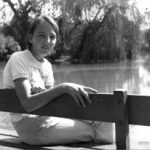
Gran and I (1975)

Gaynor Paynter – a short bio

I was born on the 21st of March 1975 in Kensington, South Africa, and, with the exception of a few years after I was married in 1996, I’ve lived here my whole life.

I went to school at Leicester Road Primary School and Jeppe Girls High where I matriculated in 1992 with a university exemption and half colours for chess (I was the captain of the chess team and was on the tennis team too).

After studying graphic design for a year, I decided it wasn’t for me and did a secretarial diploma at the then Germiston Technical College (in which I obtained a distinction in Information Processing, a fancy name for typing).

I always had an entrepreneurial flair. During school I sold artwork through advertising in the Top 40 Music Magazine, for R5 a piece! (Lots of drawings of Michael Jackson were done at the time!) I also worked part time in the local Checkers.

At Rhodes Park in Kensington about 1988A lot of firsts

My first full time job was at a company called KMI in Heriotdale in 1995 where I did reception and admin – and where I was exposed to transcribing for the very first time, transcribing notes made by one of my bosses on a small microcassette recorder!

Damian and I 2012

In 1996 I married my first, only, and still current husband, Damian, and my first son, Andrew, came along in 1998. During this time the development of technology was moving fast. Our first cellphone was the Nokia 2110 and it was an amazing phone which we shared. The very first time I went on the internet was in KMI’s showroom, during a lunch break (I surreptitiously snuck in to go on to say I’d been on!)

Getting older and getting experience

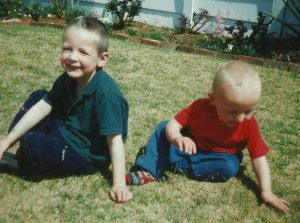
My babies Andrew and  Brandon about 2002The company ran into some difficulty and I was retrenched in the year 2000. I advertised to do typing work and did some temp jobs. I then fell pregnant with my second son, Brandon – but one employer took me on ‘semi permanently which became permanent’ – at a recruitment company, where I prepared CVs and interviewed candidates.

 The birth of Typewrite

By 2005, the internet had progressed enough for me to ‘birth’ Typewrite Transcription and Typing Services CC. (Now Typewrite Transcription and Editing Services). For three months, I worked at the recruitment company during the day, and on Typewrite by night, all the while with a husband and two little boys.

The 1st of April 2005 was the first ‘official’ day of Typewrite, although it didn’t come to be registered at CIPRO (now CIPC) until 2009.

Milestones

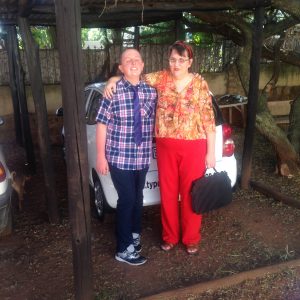
Brandon and I 2016Various milestones flag this journey. When I started I still had dial up internet. I had to soldier on with this for about a month until our ADSL was installed. You also have to have a back up internet and I’ve been through various of those, until my current ‘back up’ – my MTN cellphone. (I’ve had the same number since 1995, by the way!) Services provided have also grown and diversified – starting out with typing, adding transcribing, adding proofreading – and just recently, adding sub-titling.

Becoming an author
In 2009 I wrote my e -book  “Working From Home as a Transcriptionist in South Africa” which is a great resource for those starting out today – as I found when I started out, there wasn’t much if anything in the way of support!


TAVASA
The same year my friend and colleague Alison Fourie and I founded TAVASA – the Transcriptionists and Virtual Assistants of South Africa.

The future

Today, going into 2018, the company is still in existence – we’ve been married 21 years, and those little boys are now 17 and 19.  I’ve had the support of my husband, parents, children – and my two dogs, Scooter and Shadow.  I’m looking forward to seeing what the future holds.

Monday, November 13, 2017

Who needs a professional editor?


The question of who needs a professional editor is one I've come across a number of times. I decided it would be beneficial to post the answer here.

It's important to note that in this instance I'm referring to a WRITING editor. Not a music or video editor.

Firstly, a preamble: What is an editor?  An editor is more than someone who simply checks your grammar. An editor will make suggestions regarding content (when applicable) and style. He or she will check your formatting and lay the document out for publishing whether it be online, as a thesis or scholarly paper, a magazine article, journal, etc 

Who needs an editor?

Anyone writing a document for publication - students, authors, business people.

The reason for this is simple. Even though English may be your first language, it's very hard to spot your own mistakes. And a published document is a representation of you and / or your employer. A published mistake is a slur on your or your employer's reputation. It's no discredit to you to admit you've used an editor - in fact, anyone who knows this will appreciate your professionalism.

Someone who is writing in a language that is not their first language.

It's important to ask a first-language speaker to assist you to check that you've got all the nuances and idiosyncrasies correct. 

Someone who doesn't consider language or writing to be their strength.

We all have different strengths - I have to hire a plumber or a mechanic,  I just can't do those things. Therefore, if you are not confident in your language skills, using them to market your business might not be the best idea.  A recent example I've seen is someone advertising Christmas signs. The signs say (for example) "Christmas at the Smith's". It makes me want to ask "what smith? The blacksmith?

Have a look at my new website, Check My Writing.  Should you still have questions, or feel that YOU need an editor, contact me.

Thursday, April 20, 2017

Online marketing and other bits


So, it's been a while since I posted here .... but I met with a friend of mine today who has recently begun working in a start up (they do furniture and woodwork), and being a 'veteran' of being self-employed, I (annoyingly, probably) dished out advice.... but it was a great conversation and got me thinking. There are a number of things I did when I started out, marketing wise and also discipline wise. These things tend to fall by the way side as we go along and sometimes it does us good to remember them and do them again. Also there are things we learn along the way that are good to keep in mind.

1). Take it one day at a time. Sometimes things can get very overwhelming when you've just started out, you're used to having a salary, and suddenly month end is coming and there's no salary. Try to make plans before you start out and cover a few months' rent, medical aid etc. But spending all your time worrying about tomorrow impacts on how productive you can be today.

2). Take marketing breaks not tea breaks. This is something my friend and colleague Alison Fourie of AMF Typing told me. I haven't always followed this, but when I do, my sales esclate.

3). Set up a website. This may not sound like rocket science, but sometimes people are daunted by the whole idea of a website. The advent of things like WordPress, however, make setting up a site much less daunting than it needs to be. You simply register your domain with a service provider, and go from there. If you have funds available you can also employ a web designer. And something I learned after a while is that it's much better to have an email address with your own domain name than with a generic provider.

4). Social media. Social media can be a full time job if you do all the things there are available. There are so many outlets. Facebook, Twitter, Instagram, Pinterest, Linked In, Google Plus. My feel is that it's better to stick to a few of these and do them properly than go all out with too many and get none of them right. My personal favourites are Facebook, Twitter and Linked In. I feel that they all have different benefits. Linked In in particular is a great place to showcase your experience and skills. But make sure that your profile is extensive and detailed otherwise it may work against you. Facebook is simply the most popular platform. And Twitter has a wide open reach which gives you great exposure.

5). Your work is your reputation. Provide a good quality service and your work will sell itself.

6). Print and distribute brochures, brand your car, put up posters and signs on community boards and in local libraries. Do everything you can to get your name out there.


Tuesday, December 29, 2015

Send a file from a cellphone to a computer using Whatsapp


More and more people use their smartphones as a means to record and use Whatsapp as a method of communication. 

It often happens then that once the recording is done, they wonder how to get the recording sent to the transcriptionist. 

In a climate that is relying more and more on cellular technology (and where cellphones are used to access the internet more than computers are), I thought it would be worthwhile to explain that it is possible to send audio via Whatsapp to a computer. 

All the client has to do is send the file to your cell number as they would normally send a Whatsapp message. 

You then do the following:
1. Go to settings in your Whatsapp account on your phone. 
2. Click Whatsapp Web
3. Go to web.whatsapp.com on your computer and scan the QR code
4. You will see your messages on the left hand side. 
5. Click on the relevant message and you will be able to download the file. 

You obviously need a good internet connection to do this - I recommend wifi for cellphone and ADSL or wifi for computer. 

Wednesday, October 21, 2015

Tips on Audio Recording


The way that an audio file is recorded greatly influences the quality of the transcript. There’s no two ways about this and no way around it, no matter how good the transcriptionist. Although there is software that can help clean it up this is both time consuming and not always efficient.I do not offer recording as a service as it is a speciality on its own, but there are a number of options you as a client who needs something recorded have. The first is to outsource the function and this is probably the most secure, with the best guarantee that you will get a good recording. For this purpose I recommend AMD Solutions and if you use their services please let them know that I recommended them.


audio_ds-2500__front_left_xlThe second way is to do it yourself. There are a number of ways to do this, and if you talk to the guys at Maynards  they will be able to recommend a good recording solution.  You can also use your cellphone or laptop using recording software, but you may not be guaranteed a good outcome.
If you are doing your own recording, there are some things to bear in mind to make it as clear as possible.
  1. Try to record in a quiet place. Loud background noise, while it may not be obvious to you sitting in a restaurant or shopping centre, is very obvious to the transcriptionist trying to make out a particular voice from many in the background.
  2. Try to minimise distractions such as ringing phones, dogs barking or children making a noise.
  3. If there are a variety of speakers, you can ask each speaker to clearly identify and introduce him or herself.
  4. Record a few seconds of ambient noise. This is the room sounds without anybody talking. This allows anyone cleaning up the recording to use that section of recording as a noise sample and use software to remove that type of noise from the recording.
  5. Try to make sure that all speakers speak directly and clearly into the microphone. If someone is sitting across the table and not speaking into the microphone, that person’s contribution may be lost.
  6. Try not to record in the vicinity of loud machinery or activities.
  7. Some form of noise is inevitable and expected in transcripts, but much can be avoided.

Tuesday, October 20, 2015

Audacity Noise Removal

I have recently discovered how to clean up audio using the freeware software Audacity and I thought I would share it.

This might not be rocket science to anyone else, but it took me a while to discover.

When I say this I should point out that it is versions of Audacity before version 2.1.0 that I am referring to. You can talk about being on the slow bus, but I haven't figured out the supposedly much improved 'Noise Reduction' function of later versions. Anyway, it's actually fairly simple when you know how.

1) Open Audacity.
2) Load your audio file.
3) Select a small section of the file that contains the noise you want to get rid of.
4) Go to the Noise Removal function in the Effects tab.
5) Click 'Get Noise Profile' and here it will allow you to get a preview of what your new file will sound like.

6) Go back to your file and select the whole thing.
7) Go back to Noise Removal and hit 'remove noise'.


 Bob's your uncle! It takes a while to do fairly big files and then to save them as well - but I have achieved some very good results doing this. It's prudent, if you have any control over how the file is being recorded, to record a few seconds of ambient noise - meaning just room noise without talking. Then, when you get to Audacity, this will be the section you select for your noise profile, and all similar sounding noise will be removed from your file.

Monday, May 04, 2015

Why a Transcriptionist is beneficial in the Insurance Industry

The transcription service is relevant and beneficial in just about any industry.  Small business owners become stressed with the amount of work load they have and being able to outsource functions saves stress and makes life easier and larger companies can outsource this function in order to streamline their operation. Insurance administration can be a nightmare if you try to handle it on your own. So why not get a professional to help?

If you work in the insurance industry, you probably record your phone calls and dictate your reports. If you own your own small business, you probably do the work later on yourself. Both of these can be uploaded and sent to a transcriptionist to type. This is cheaper than having a permanently employed member of staff, and you don't have to worry about overheads like salaries, electricity and equipment. The transcriptionist, as a freelancer or a business owner, takes care of this. 

Because this function may not be your strength, it can also be to your benefit to have someone more proficient at it do it. They will be faster, more efficient, and it will leave you  more time to tackle your strength - which is running your business. 

This means that by the time you get back to your office, your calls and reports can be ready and waiting for you at your desk.  It can be helpful to you if you work at your desk or if you are on site doing assessments.  The time you save doing this helps you achieve a faster turn around time and makes you look more efficient in the eyes of your client. 

Larger insurance companies, which make use of call centres and other larger groups of staff, can also benefit by using a transcriptionist.  All call centre, telephone and admin staff can send out their calls to be transcribed, leaving them free to process calls and handle the administration functions. This leads to a much more stress free environment. 

All forms of insurance companies and insurance consultants can benefit from this - life insurance, pension, liability insurance, auto insurance, medical insurance or medical aid, property insurance, funeral cover, etc - even pet insurance! - giving you peace of mind to keep customers happy. 

To summarise, the benefits include:
- Saving stress
- Making life easier
- Streamlining the operation 
- Cost reduction
- Increased efficiency

Contact me for a quote on typing and transcription services today. 

Monday, May 19, 2014

S is for Story Pot

Interview with Damaria Senne - author of amongst many things the Story Pot Blog. 

Essentially Damaria, who is a long term friend of mine, is my inspiration and mentor when it comes to blogging. D's the writer I wanna be. And it's my pleasure and honour to interview her here today. And so S is for Story Pot. 

Damaria Senne Biography

I am/ have been many things: a sister, friend, mother, partner, aunt, daughter, an activist, journalist, writer, communications specialist, blogger, publisher, care-giver, homemaker and gardener.
My career objective is to write about the big adventure that we call life; my stories and other people’s stories; fiction and non-fiction. The medium and genre may vary depending on publishing requirement. All I want is that the stories are shared.

The Interview

From the blog: Launched in January 2006, STORYPOT started as a place for Damaria to showcase her children's stories and talk about her writing life. She loved the way the blog helped her make new friends, learn from them and share with them . But, at the back of her mind, there was always that niggling thought that a blog called Storypot should be about more than just one writer, cooking up a wide variety of stories and plots. Then opportunity came knocking and Pam joined her....

I've always been quite intrigued by the name StoryPot. I like it and think it totally works, but why Story Pot as opposed to Story Site or Story Page?

As you know I love food: growing it, tending to it, cooking it and sharing it with my friends and family. So when I named Storypot, I was saying, this blog is where I cook up all the stories that I publish. They can be fiction or non-fiction, for children or adults, for print, radio, TV or online, it doesn’t matter. All my stories are cooked in this pot.

The ingredients for these stories are all the elements that affect my writing – my job, friends, family, acquaintances, people I meet online and offline, my house, garden, the books I read, the movies I watch, the music I listen to.

So my blog visitors get the behind-the scenes look of the stories as they evolve (cook), even when I don’t know the story is cooking. Does that make sense?

Do you still collaborate with Pamela Moeng? Chat to us about that collaboration. 

Pam and I are old friends; sisters really. We met more than 20 years ago when we both lived in Mmabatho and we became good friends then.

So we’ve supported each other through career moves, writing projects, family crises, life really. We chat every day; by email. We share about what we’re working on, the people we meet, what we read, stuff that bug us… whatever.
So it made sense that if I was going to share my blog with anyone, it would be her.

For the past 18 months or so we’ve been co-writing a course for a client (with other people). We’ve also tackled some small projects together too.  It worked well enough.

But we didn’t work as closely as I had hoped (we worked more in tandem rather than together). Part of the reason is that I was busy with Mma’s health issues and Pam has a day job and we both had other projects too.

2014 brings us an opportunity to work on more projects together, and we plan to both make the time for joint projects that allow us to work more closely together.

Story Pot started as a blog for your own children's books, but you've got a number of business related and other books for sale on there. Where do you see the direction of Story Pot going in the future?

That’s the question that I have been asking myself lately. Luckily, you asked after I did have some answers for myself and my readersJ

The short answer is that Storypot is a lifestyle blog, with specific focus on a writer’s life. You are right that Storypot started out focusing on my children’s stories, but it turned out that I had more than just children’s stories inside me. So as I said, readers get the front row seats to watch as the stories I write develop; they see various elements of the life affecting my writing. Some of it is clear from the beginning that it’s going to end in a story, some of it only shows up later.

My typical audience, I think is made up of mothers/ writers/ bloggers/ gardeners/ homesteaders/people who share a common interest or cause with me.

As to my desired audience, I want to attract people who can use what I publish. For example, I would like to attract mothers looking for children’s stories to read for their kids at bedtime, or bloggers who want to promote their work more in the media, or small business owners who recognise that being a writer/ blogger is a business and want to share their learning with me and may teach me a thing or two.

I do hope that virtual assistants in this blog tour find “How to get quoted in the media”to be a very useful tool for their businesses. The one thing to note is that the ebook focuses on getting positive media coverage without having to spend money. When you pay, it’s advertising, and not media coverage and not the subject of the book.

Secondly, I’m dropping the price of the ebook  for the duration of the blog challenge (28 weeks).

Do you have a favourite book that you've written, or something special about each of them that you'd like to mention?

Waking Up Grandma is special to me because I was thinking of my mother as I wrote it. And it’s contemporary and funny…. 

The message in The Doll That Grew stood the test of time. That story was first published eons ago, and its message is still relevant today. And that’s not just me saying that because I’m attached to it: last year the primary school my nephew attends did an end –of- year skit, and guess which story was adapted for the stage? Yup! The Doll That Grew!

How toget quoted in the media is special to me because I did it with a good friend. Christelle and I worked very closely together – and fought a lot about the details – but that’s what made it so rewarding. In the end, we brought out the best in each other. Though there were moments when I would have happily wrung her neck (because she wouldn’t let me get my way) and she felt the same too!

Tselane and the Giant, which I’m releasing through Damaria Senne Media on Amazon in the first quarter of 2014 is special to me because it brings back warm childhood memories. 

We even grew up calling my younger brother Boitshoko, yes, he who was named for the main character in the newly literate adult reader Boitshoko (published by Heinemann SA in 1996), Dingwe, which means Giant, because he loved the story so much, especially the parts where the Dingwe character talked.

What projects are you currently busy with?

Phew! I have lots going on. Unfortunately, I have the attention span of a gnatJ So I have the following tasks in my projects queue:

Publish on stories Amazon – a children’s story (Tselane and the Giant) and a novel (both have been through edits. The cover of the children’s story is already done; both also need to be proofread)

Finish writing an anthology of children’s stories with a co-author - We have some good stories done already, so it’s a matter to adding more and starting edits. This collection will also be published through Amazon.

Update and promote my blogs more aggressively. Without the aggressive marketing, the books won’t sell.

The blogs that will receive the most attention are:
Free African Tales (http://freeafricantales.blogspot.com ) – Where I moved my children’s stories in 2006 when Storypot changed

Write and submit stories under a pen name. This is a critical move in my business, as I want to have less client-based income and more book publishing based income.

You have another blog, called Growing Our Food. I love the concept of everyone being self-sustainable. Tell us about that. 

My mother has diabetes and high blood pressure, and that means that she has to eat a low-fat, low-salt diet that’s pretty heavy on veggies and fruit.

Additionally, I’ve always felt overweight and have ulcer. So I had to find a way to feed us really well and make sure that we have variety enough we don’t get bored with the healthy meals. This meant either spending a fortune on fresh food or growing it ourselves. And being the writer and blogger that I am, I had to document it J.

So the blog reflects my gardening life –  resources I’m reading/watching, what I’m doing in my own garden and the lessons I’m learning as I go along.

Is Growing Our Food a way to try to help the community and educate people?

It struck me very early in the gardening game that many people find it very intimidating. It looks like complicated, hard work for very little return. And why bother when you could get fresh, much prettier-looking veggies and herbs from the Food Lover’s Market?

Me? I decided I didn’t mind being a serial killer: if I plant it, then kill it, it’s  fine. I’ll just plant again, kill it again.. until I figure out what I’m doing wrong and fix it. Meanwhile, I’ll enjoy what I couldn’t kill.

Turned out that there were a lot of vegetables and herbs I couldn’t kill. And I wanted to share that knowledge with people, show them that it was not as hard as they feared. And it’s very good exercise. Very relaxing.

My hope it that my blog posts will inspire other people to garden, or try one more time if their crops fail, and to teach them what they need to do through my experiences.

It’s also a sustainable way to use the resources we have for food.

Who is Damaria Senne and what's in the future?

I am/ have been many things – a sister, friend, adoptive mother, partner, aunt, friend, daughter, an activist, journalist, writer, communications specialist, blogger, publisher, care-giver, homemaker and gardener.
I’m a mass of contradictions. I operate best when I’m solitary, but love people. I’m somewhat shy but laugh loudly and heartily.
I’m very practical, looking at all sides of an issue before taking most actions, yet I’m prone to impulsive actions that change lives (mine and other people’s).
I’m a science geek (Chemistry major with minors in Physics and Maths) who decided that a life of creative writing suited her best.
So what’s in my future?  Books. Lotsa books.